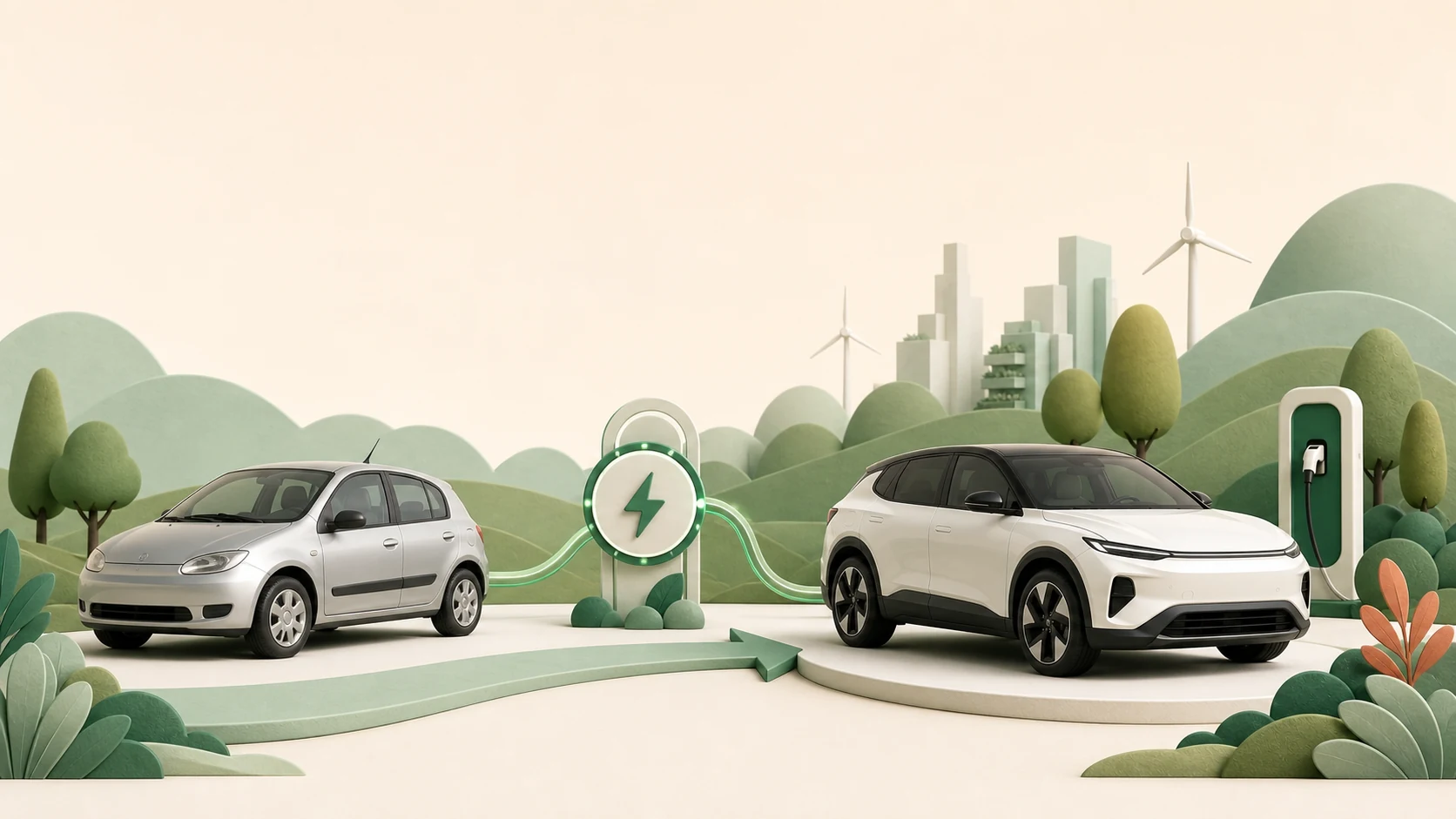
EV switching guide

Coming from a Hyundai Kona Electric (first generation)?

Should you switch from Hyundai Kona Electric (first generation) to Kia EV6?

A practical answer based on range, charging, compatible stations, running costs and the features you use every day.

Today H

Reference model

Hyundai Kona Electric (first generation)

Range
390 km*
Battery
64 kWh
DC charging
61 kW
Next K

Reference model

Kia EV6

Range
455 km*
Battery
80 kWh
DC charging
205 kW

If your battery still covers your daily loop comfortably, keeping the Kona Electric is rational. Switch when charging or range starts deciding where you can go.

Last reviewed 17 July 2026 Figures are PlugSphere estimates comparing the Kona Electric 64 kWh (MY22-23) with the EV6 Long Range 2WD reference variants — not laboratory results.

Quick answer

Meaningful upgrade

This switch fixes more limitations than it creates.

The Kia EV6 brings several practical improvements. It makes most sense if those changes solve problems you already feel with the Hyundai Kona Electric (first generation).

Range per charge

Current · Kona Electric

390 km

New · EV6

455 km

65 km more range

10–80% charging

Current · Kona Electric

54 min

New · EV6

22 min

32 min less waiting

Charging stops on a 600 km day

Current · Kona Electric

2 stops

New · EV6

1 stop

Fewer charging breaks

Your result

What changes if you switch?

Start with what improves, then check the trade-offs and what will still feel familiar.

What gets better

5
Real-world range
390 km → 455 km (+65 km)
10–80% fast charge
~44 min → ~22 min at a 150 kW charger
Battery preconditioning
Full charging speed on cold days — your Kona Electric has no battery preconditioning.
Vehicle-to-load (V2L)
Power appliances from the battery — your Kona Electric has no vehicle-to-load (v2l).
Cargo space
332 L → 542 L

What gets worse

1
Efficiency
164 Wh/km → 176 Wh/km

What stays familiar

3
Seats
5 seats in both
Body style
Both are suvs
Charging plug
Same Type 2 CCS port — every charger you use today still works

Side by side

Your Kona Electric

EV6

Estimated range
390 km*
455 km*
Useable battery
64 kWh
80 kWh
DC charging
61 kW
205 kW
AC charging
11 kW
11 kW
Energy use
164 Wh/km
176 Wh/km
Seats
5 seats
5 seats

*Estimated mixed-condition real-world range. Missing database values are omitted or marked unavailable.

For you, the owner

What it means in real life

A specification only matters when it changes your routine. Here is how moving from your Hyundai Kona Electric (first generation) to the Kia EV6 translates into ordinary weeks, longer journeys and the habits you already have.

01

Your normal week

What you will notice day to day

You gain about 65 km of estimated real-world range, so you can leave a larger buffer instead of watching the remaining percentage as closely. At the same €0.30/kWh home tariff, allow about €36 more per 10,000 km; the newer car is not the cheaper one to power in this pairing.

02

Beyond the daily commute

How road trips will feel

On a 600 km day, our route estimate falls from 2 charging stops to 1. That means less planning and more freedom to pass a busy charger. For a 10–80% top-up, the estimates move from roughly 54 minutes in the Kona Electric to 22 minutes in the EV6 under the stated charging assumptions. Compatible-station coverage is unchanged, so every charging location counted for your current plug remains represented.

03

Living with the car

Comfort and habits that change

Both cars have a heat pump, so efficient winter cabin heating remains familiar. Battery preconditioning also means the new car can prepare its pack before a fast-charge stop on cold days. You keep the same 5-seat capacity.

The honest decision

Should you actually make the switch?

The case for switching

Switch if real-world range, 10–80% fast charge, battery preconditioning solve frustrations you feel regularly. The move should remove a real limitation—not simply put a newer car on the driveway.

The case for keeping your car

Keep the Hyundai Kona Electric (first generation) if it still covers your routine comfortably and its charging stops do not shape your journeys. You also avoid giving up efficiency. Some Hyundai Kona Electric (first generation)s are now around 7 years old, but age alone is not a reason to replace a healthy battery.

Charging

Your charging world, before and after

Compatible-location counts come from PlugSphere’s charging-station database and each reference car’s stored plug standard.

Check a route with the EV6 →

Today

Hyundai Kona Electric (first generation)

144,123

compatible charging locations

Plug
Type 2 CCS
DC fast locations
38,056
10–80% estimate
~54 min

After switching

Kia EV6

144,123

compatible charging locations

Plug
Type 2 CCS
DC fast locations
38,056
10–80% estimate
~22 min

DC fast locations are matched at 50 kW or more. Counts change as the station database is refreshed.

Your Hyundai Kona Electric (first generation) today

What your car likely holds now

The oldest Hyundai Kona Electric (first generation)s are now ~7 years old. Fleet telemetry puts typical degradation at 1.5–2% per year — the bands below apply that to each version's original range.

Kona Electric 64 kWh (MY18-19)

2018–2019
Original*
390 km
Likely today*
328–343 km

Kona Electric 39 kWh (MY18-19)

2018–2019
Original*
245 km
Likely today*
206–216 km

Kona Electric 64 kWh (MY20-21)

2019–2021
Original*
390 km
Likely today*
338–351 km

Kona Electric 39 kWh (MY20-21)

2019–2021
Original*
245 km
Likely today*
212–220 km

Kona Electric 64 kWh (MY22-23)

2021–2023
Original*
390 km
Likely today*
350–360 km

Kona Electric 39 kWh (MY22-23)

2021–2023
Original*
245 km
Likely today*
220–226 km

*PlugSphere estimates; actual battery health varies with climate and charging habits. We never estimate used-car prices.

Money

Running cost and purchase price

Running-cost estimates use the same €0.30/kWh home tariff for both cars. Purchase prices appear only where a current market record exists.

Current EV6 prices

Germany
€49,990
Netherlands
€49,495
United Kingdom
£45,635

Switching from a Hyundai Kona Electric (first generation) — real questions

Answers computed from both cars' data.

Is it worth switching from a Hyundai Kona Electric (first generation) to a Kia EV6?

If range or charging speed limits you, the data shows you gain 65 km of real-world range and a 10–80% stop of about 22 minutes. If your Kona Electric still covers your daily loop comfortably, keeping it is a rational choice.

What will I find different coming from a Hyundai Kona Electric (first generation)?

Real-world range, 10–80% fast charge, Battery preconditioning — while giving up efficiency.

What do you give up moving from a Hyundai Kona Electric (first generation) to a Kia EV6?

Efficiency (164 Wh/km → 176 Wh/km).

Should I sell my Hyundai Kona Electric (first generation) or keep it?

The oldest Hyundai Kona Electric (first generation)s are now about 7 years old and have typically lost 1.5–2% of range per year. The case for switching starts when you charge to 100% daily just to feel safe, or when fast-charging stops dictate your routes.

Next steps

Test the switch against your life

Use the route you actually drive, then inspect the full reference-car record. That will tell you more than another generic best-EV list.

Other options from a Hyundai Kona Electric (first generation)

Privacy controls

Necessary

Security, requested features, the consent record and the one-time loading animation.

Always on

This first-party panel manages PlugSphere preferences; it is not a Google/IAB-certified advertising consent platform. Your privacy choices